Should Your Small Business Use AI? An ROI-First Decision Framework
AI hype fatigue is real. Here's a practical, ROI-ranked way to decide where AI actually pays back for an SMB — plus the honest tradeoff between AI consulting...
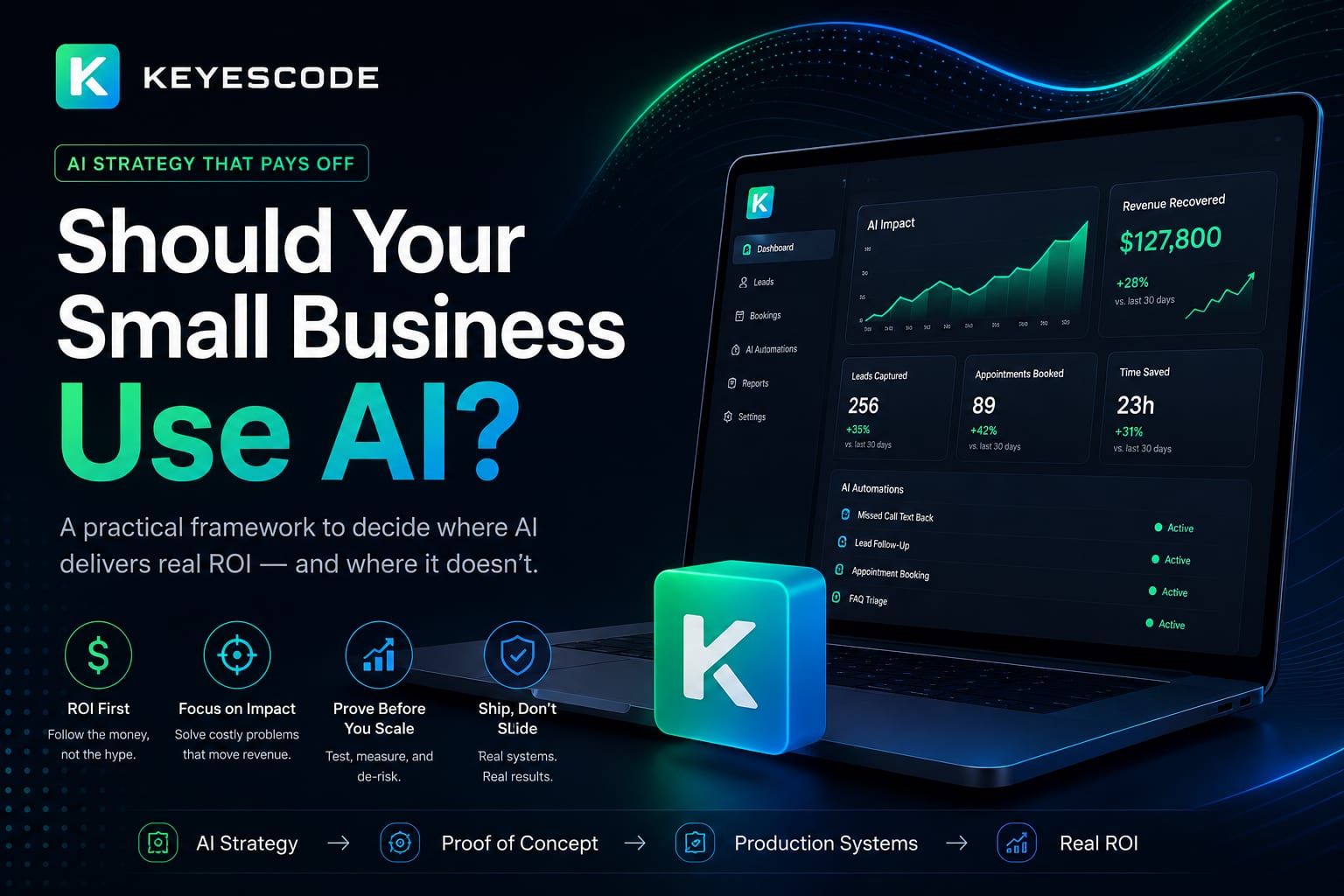
Every founder I talk to has the same two questions: should my small business use AI at all, and if so, do I hire someone or bring in outside help? The honest answer to the first one is: sometimes. AI is worth it in specific places and a waste of money in others. The job is knowing the difference before you spend.
This is a practical framework for making that call — and where AI consulting fits, if it fits at all.
Start with the money, not the model
Most AI advice starts with the technology. That's backwards. Start with the number.
Ask one question about any process in your business: what does this cost me today, and what would it bring back if it were faster, cheaper, or didn't get dropped? If you can't estimate both sides, you're not ready to spend on it yet.
The strongest AI ROI in an SMB usually hides in three places:
- Revenue you're losing right now. Missed calls that go to voicemail, leads that never get a follow-up, quotes that take three days. These have a dollar value you can calculate from your own AOV and close rate.
- Repetitive work with a clear input and output. Support triage, data entry, appointment booking, first-draft content. Work that's expensive because a person does it over and over.
- Decisions that stall for lack of a summary. Call QA, report generation, pulling signal out of a pile of documents.
Where AI usually isn't worth it (yet)
We'll tell you where AI is worth it — and where it isn't. It's usually not worth it when:
- The process runs a handful of times a month. Automating something that takes you 20 minutes a week won't pay for the build.
- The task needs judgment you can't define. If you can't write down the rule, an AI can't reliably follow it.
- You're doing it because a competitor announced they were. That's hype fatigue talking, not ROI.
Buying AI that doesn't move revenue is easy. Avoiding it just means being honest about payback.
How to estimate payback
Keep it simple. Take the annual cost of the problem (hours lost times loaded hourly cost, or leads lost times your close rate times AOV). Then estimate the build-and-run cost of the fix. If the problem cost is several times the fix cost, it's a candidate. If it's close, skip it. You don't need a spreadsheet with 40 rows — you need the two biggest numbers to be obviously far apart.
AI consulting vs. hiring in-house
This is the real fork in the road, so here's the honest version.
Hiring in-house gives you long-term ownership, but the cost and time-to-value are steep. A capable AI engineer is expensive, hard to find, and takes months to hire and ramp. If your AI needs are ongoing and central to the product, that investment makes sense. If you're still figuring out whether AI belongs in your business at all, you're taking on salary and hiring risk before you've proven the idea.
AI consulting trades some long-term ownership for speed and lower risk. Done right, it means senior engineers who ship production AI systems — not analysts handing you a slide deck and an invoice. You get a plan and working software fast, and you keep the option to hire later once you know what's worth building.
The wrong version of consulting is a strategy document you can't act on. The right version ends in something running.
How our AI Consulting path works
We built our process to answer the payback question with data, not opinions.
- Readiness audit. We look at your stack, your workflows, and where money is leaking. Vendor-neutral — we recommend the right tool, including "none" when that's the answer.
- ROI-ranked strategy and roadmap. You get a short list of AI opportunities ordered by return, not by what's trendy. It's yours to execute with or without us.
- 2–4 week proof-of-concept sprint. We build the top idea against your real data before you commit to a full budget. If it doesn't prove out, you've spent weeks instead of quarters.
Proof: one system instead of stitched-together subscriptions
Take Corner to Corner Cleaning Solutions. We built them a Next.js marketing site backed by NestJS and Postgres, with a custom admin portal that manages leads, contacts, and bookings end to end — one system that runs the workflow instead of a pile of disconnected tools.
That's the pattern we look for: businesses paying for tools duct-taped together, when one system built for the actual workflow costs less to run and doesn't break. AI belongs inside that kind of system where it moves a number — not bolted on for its own sake.
If you want to know where AI is actually worth it in your business, book a free 15-minute AI audit. We'll review your stack and map 2–3 AI integrations you could ship in 30 days — no strings.
Want this kind of result for your business?
We'll audit your site for conversion gaps and suggest 2–3 AI integrations you could ship in 30 days. No pitch, no pressure.