How We Built Café con Andrea: A Headless Shopify Storefront for Honduran Specialty Coffee
Café con Andrea sells one coffee, Honduras High-Grown, grown at 1,600 metres in Cerro Grande, La Labor. We built its online store as a custom headless Shopify storefront: an editorial site that tells the coffee's story, with Shopify handling the products, cart and checkout, and a strict rule against showing customers anything the brand can't back up.
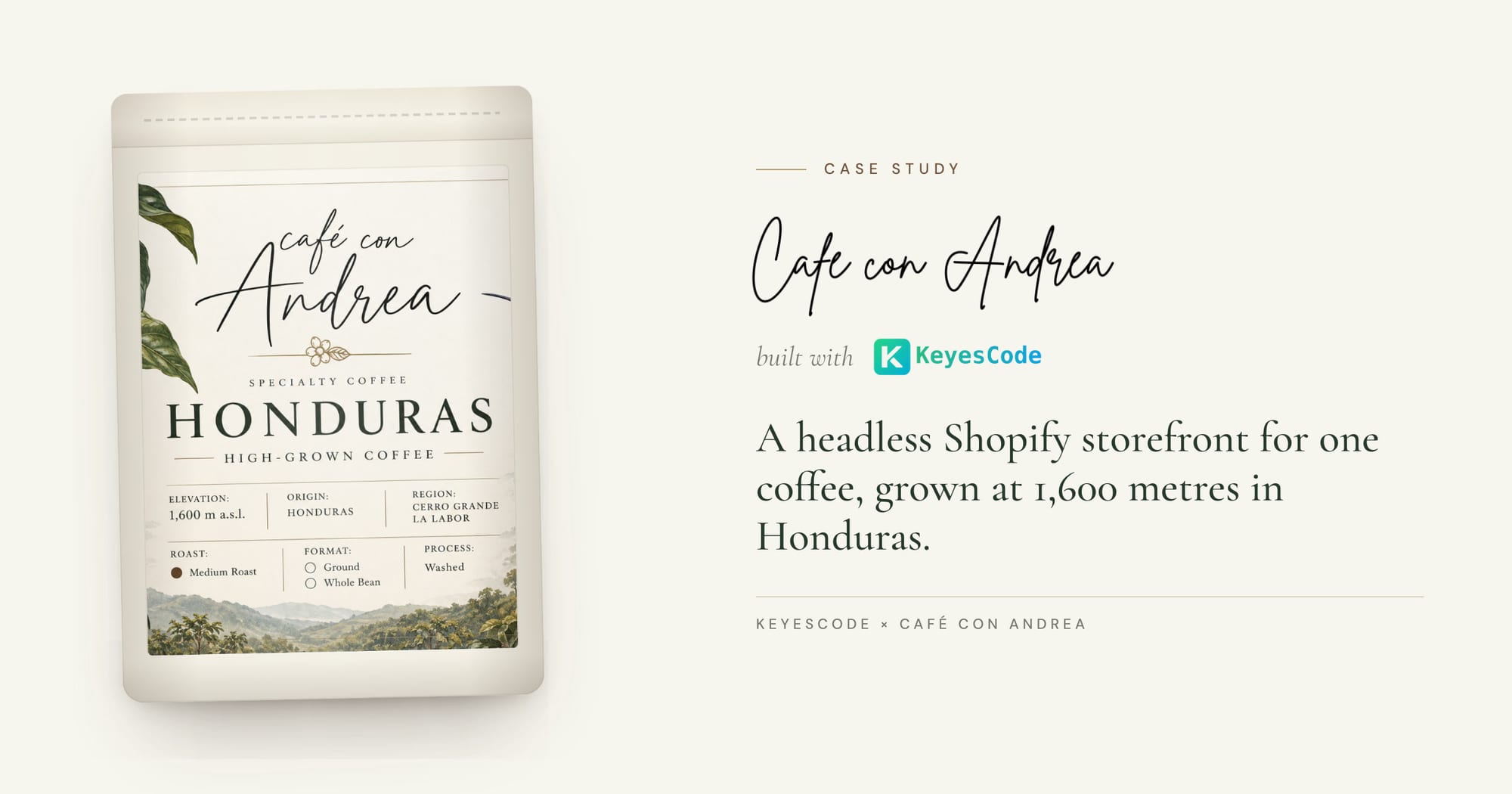
Café con Andrea sells one coffee. It's called Honduras High-Grown, it comes from Cerro Grande, La Labor, in the Honduran highlands, and it's grown at 1,600 metres, washed, and roasted medium. The brand had a hand-lettered logo, a beautiful packaging label with a watercolour coffee branch and a hummingbird, and a clear idea of how it should feel: elegant, warm, premium without being intimidating.
What it didn't have was a store. The brief was specific: not a generic Shopify template, but a distinctive, editorial storefront that tells the coffee's story, works beautifully on a phone, and actually sells, with Shopify still running the business underneath.
This post covers what we built, the rules we set ourselves, and a few decisions that shaped the site.
The brief: a luxury feel, real commerce, and no invented claims
The owner's brief ran to 24 sections, but three ideas carried most of it.
- It should feel like a premium lifestyle brand, closer to a fragrance house or specialty roaster than a typical online shop: refined serif headings, cream and forest-green colours, botanical detail, restrained motion.
- Shopify stays in charge. Products, prices, inventory, orders and checkout all live in Shopify. The website reads from it and never second-guesses it.
- Nothing on the site may be made up. The brief ended with ten hard rules: no invented prices, bag sizes, reviews, founder details, tasting notes or shipping promises, no fake checkout, and no buttons that don't do anything.
That last point turned out to be the most important design constraint of the project, and we'll come back to it.
What we built
Café con Andrea is a headless Shopify storefront. Shopify runs the store; the website customers browse is a custom Next.js site that reads products, prices and inventory through Shopify's Storefront API and hands the cart to Shopify's own checkout when the customer is ready to pay.
The site has fourteen routes: the homepage, the shop, the product page, Our Story, Our Coffee, a Brew Guide, FAQ, Contact, a cart page, search, and four policy pages. Every one of them has proper loading, empty, error and not-found states.
The homepage
The homepage opens on the brand's own coffee-bag film behind the line "Every Cup Has a Story.", with the coffee's region, elevation and roast set underneath. The film is muted, loops, and has a pause button; visitors who have asked their device to reduce motion see a still frame instead.
Below it, the page moves from product to place to ritual. The flagship coffee comes first, with its live Shopify price and an Add to cart button that works right there on the homepage.
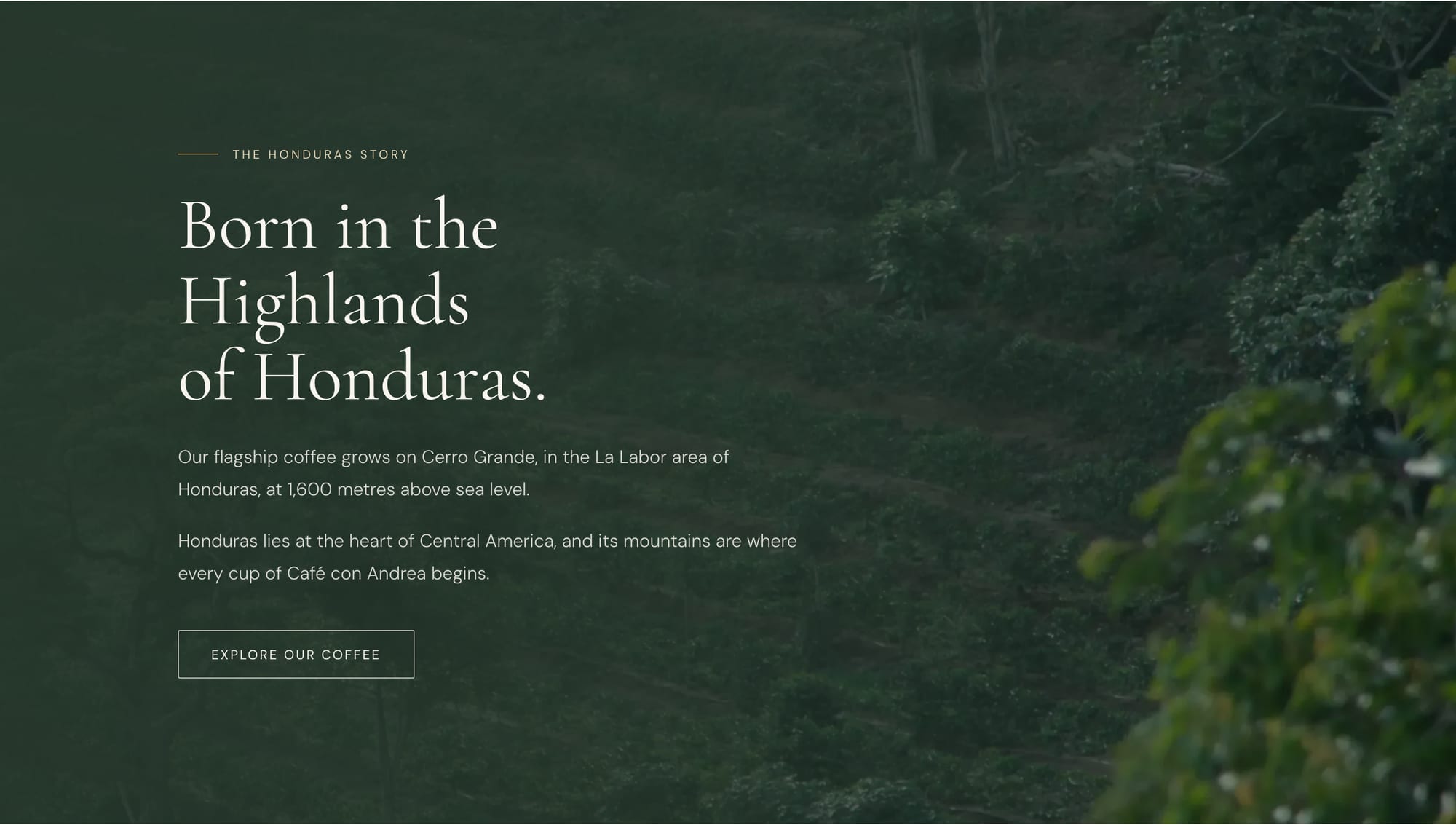
Then the story of where it grows: "Born in the Highlands of Honduras." The copy says only what the label says: the region, the elevation, and Honduras's place in Central American coffee. No farm names, no sourcing relationships, nothing the brand can't stand behind.
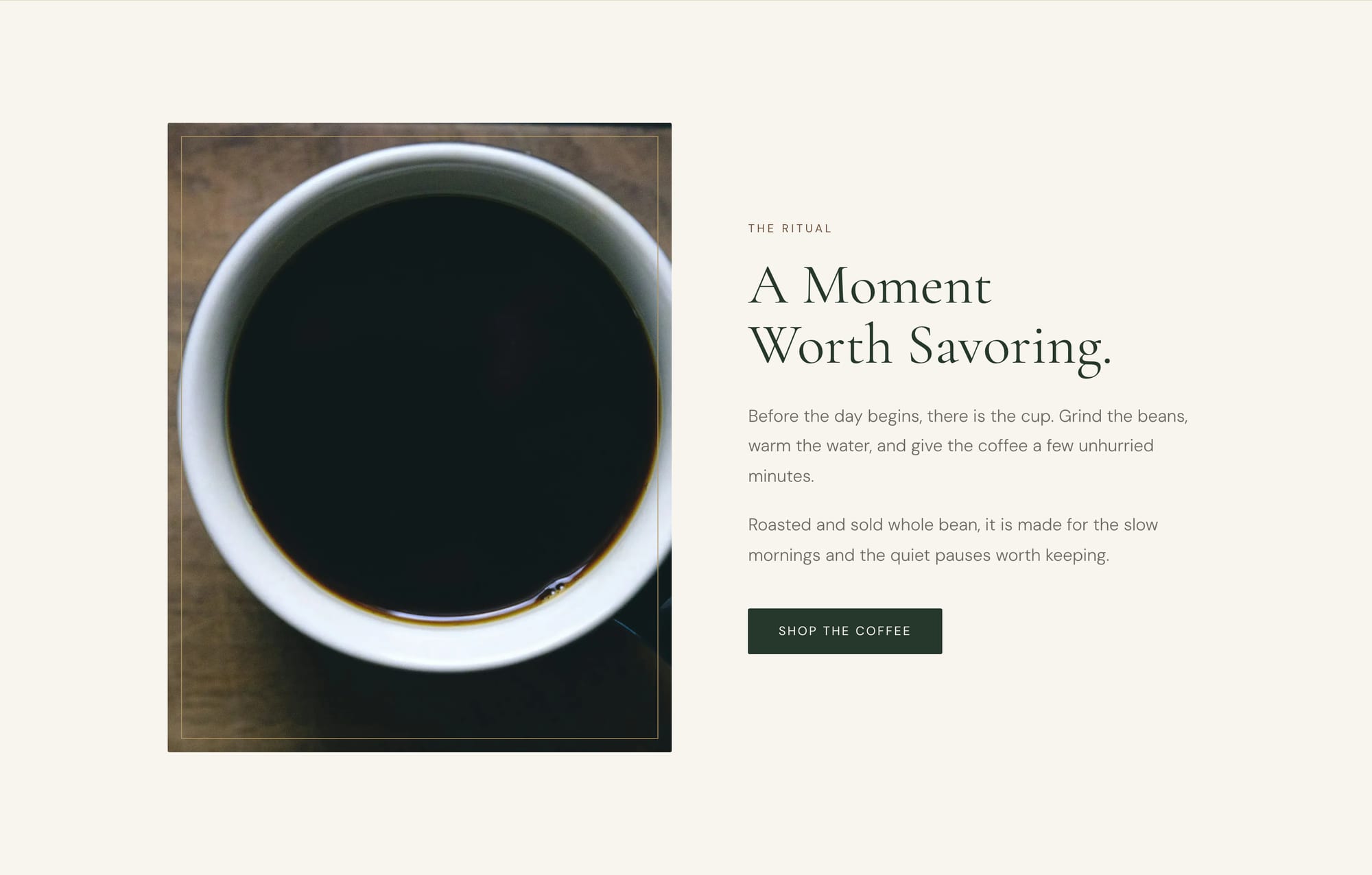
A ritual section, "A Moment Worth Savoring.", closes the page before the newsletter and footer.
The product page
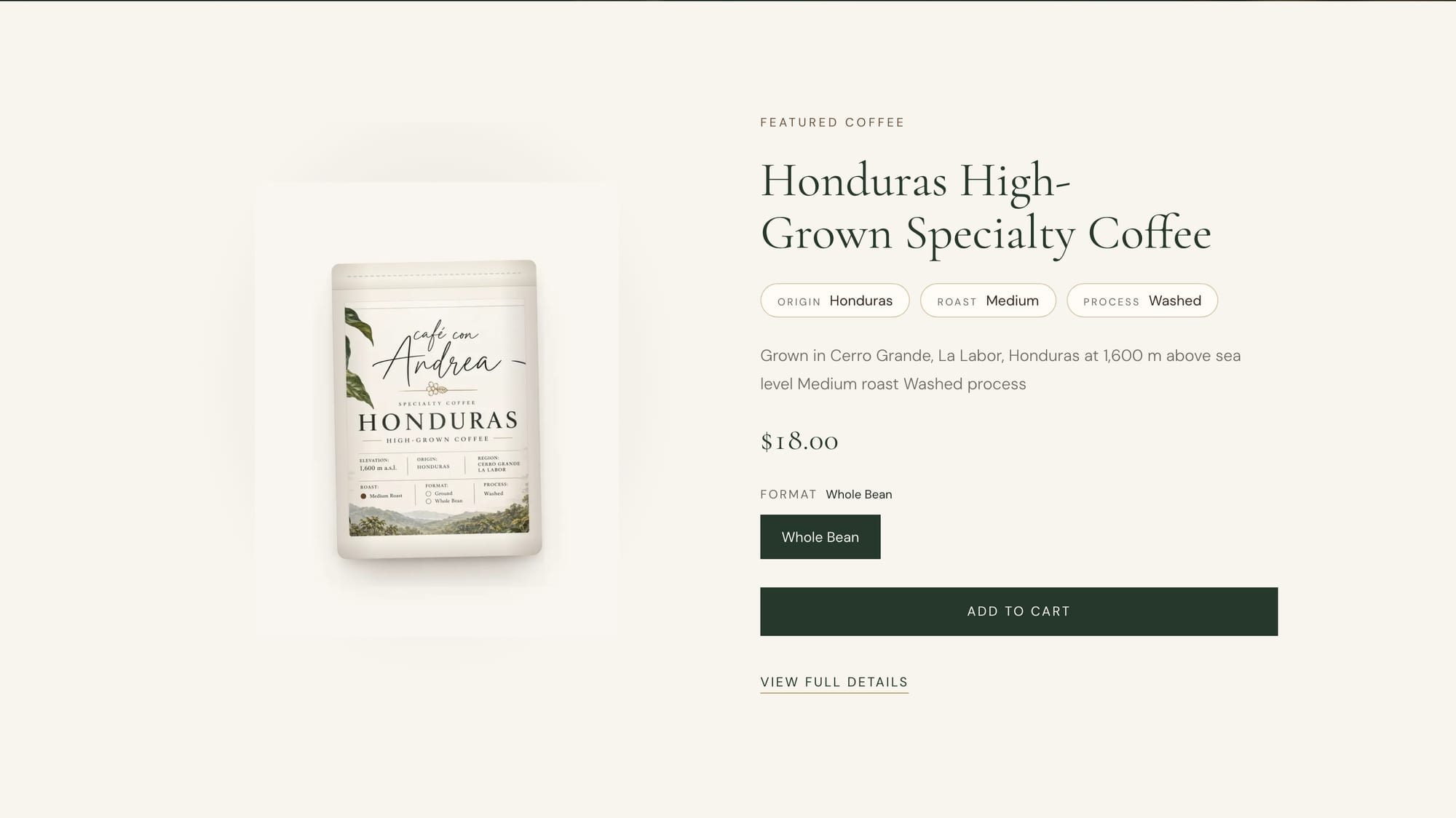
The product page is the page that sells, so it got the most attention. On desktop the coffee sits large on the left with zoom; on the right are the title, the live price, the coffee's details, the format, quantity, availability and Add to cart, with a link to the shipping policy instead of a shipping promise.
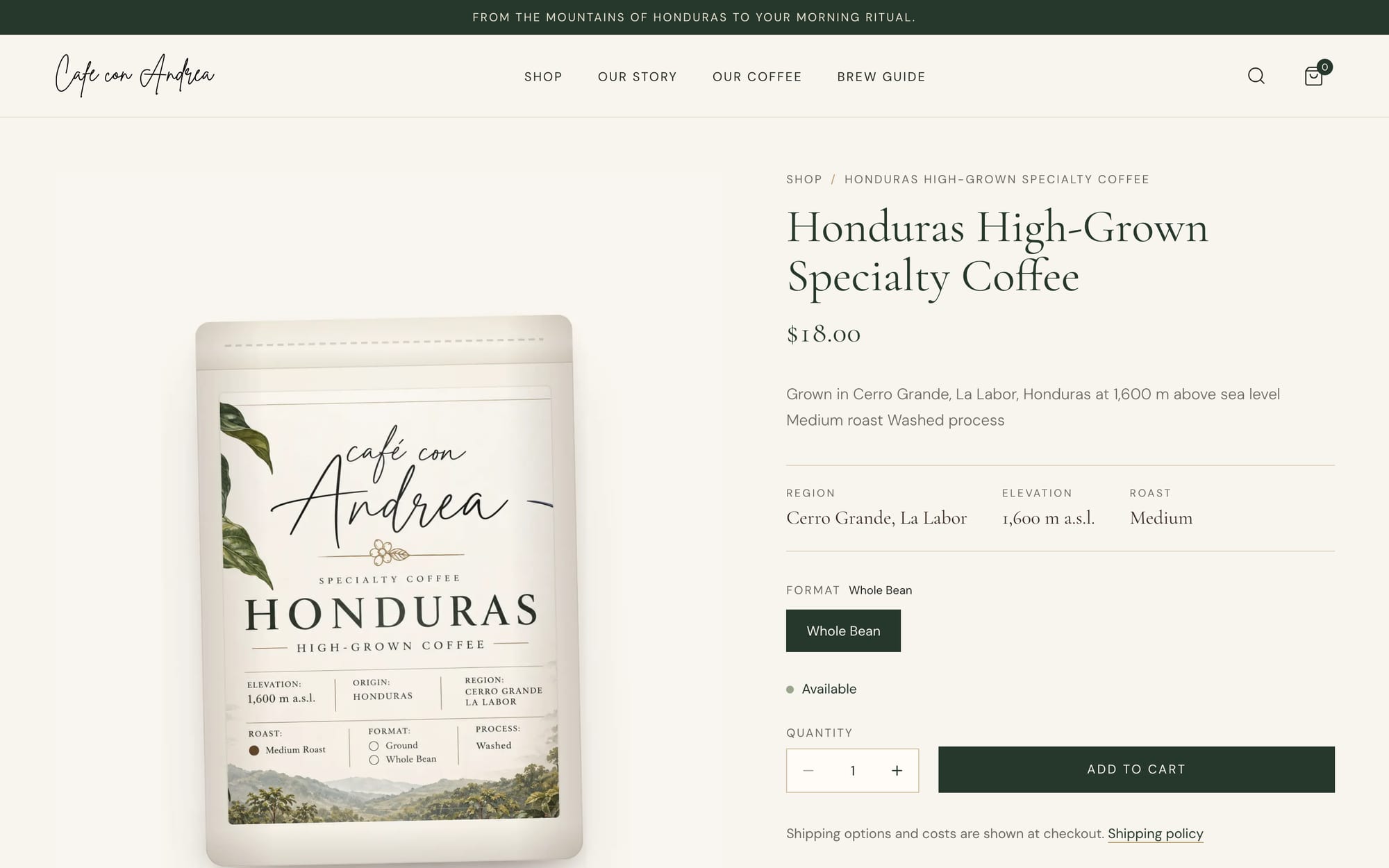
Everything commercial on that page comes from Shopify: the price, the variants, the availability, and anything Shopify adds later. If the owner adds bag sizes, the size picker appears by itself. If a variant sells out, the button says so. The site never hard-codes a price, a product ID or a stock level.
Cart and checkout
Add to cart opens a drawer on the right with the item, its format, quantity controls, a subtotal from Shopify and a Checkout button. There's also a full cart page. The cart lives in Shopify; the browser only keeps a cookie with the cart's ID, so a customer can leave and come back to the same cart.
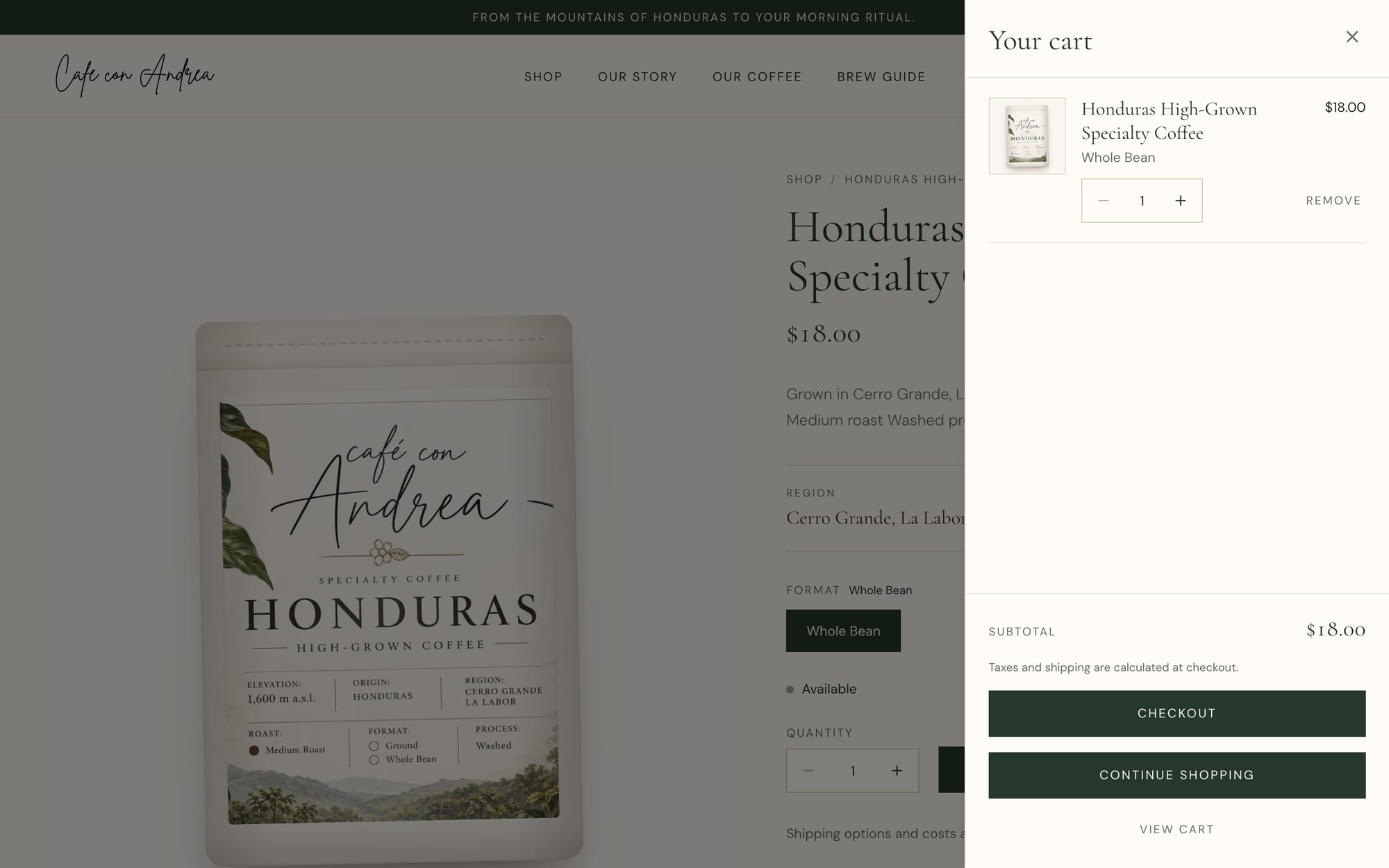
Checkout hands the cart to Shopify's hosted checkout, which handles payment, taxes and shipping, and we styled it with the brand's logo, colours and fonts. The custom site never shows a payment form, and it never says an order went through until Shopify does.
Built for the phone first
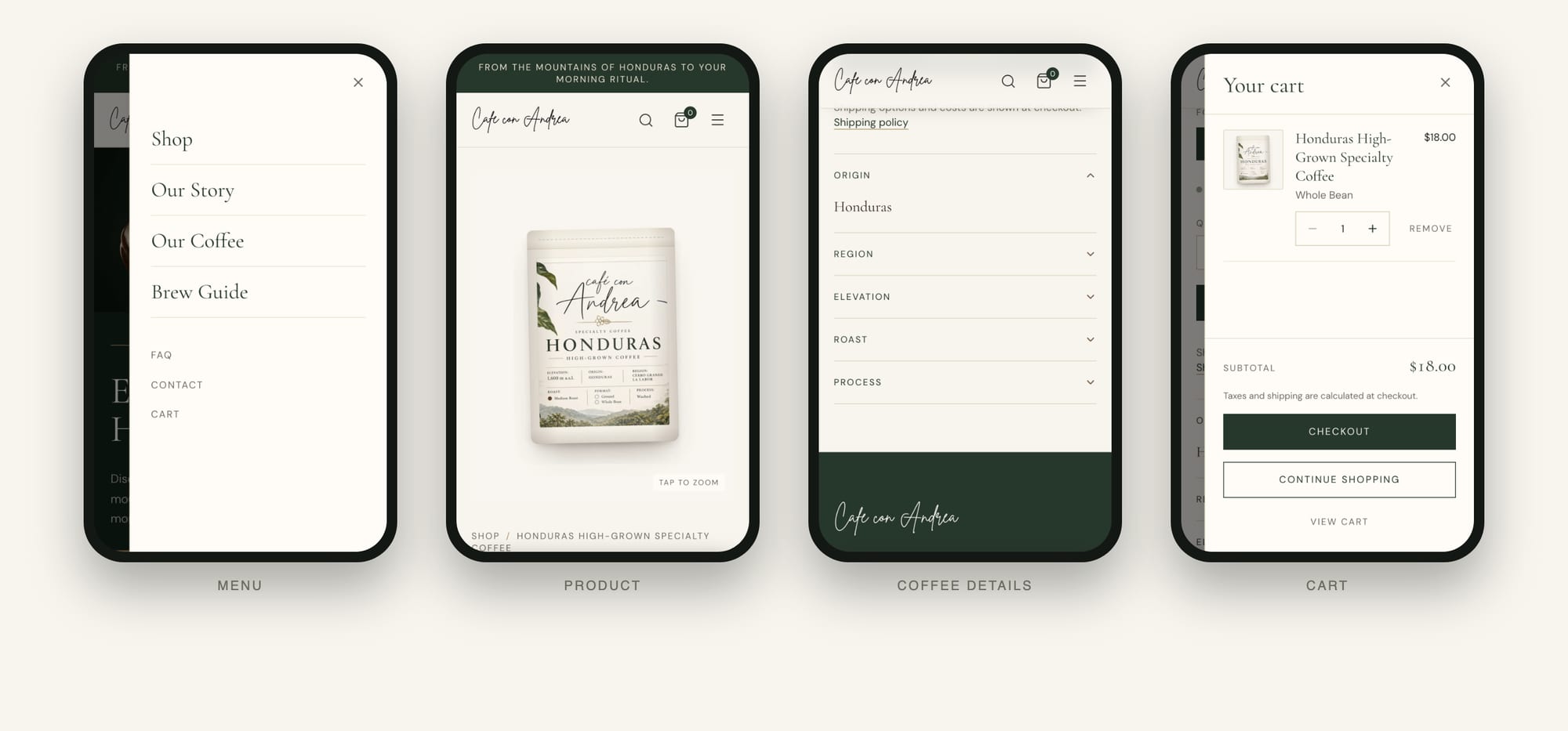
Many customers will find the coffee on their phone, so we designed every page for the phone first and treated the desktop layout as the second case. The menu, the product page, the coffee details and the cart were each designed for a thumb rather than shrunk down from desktop.
The editorial pages
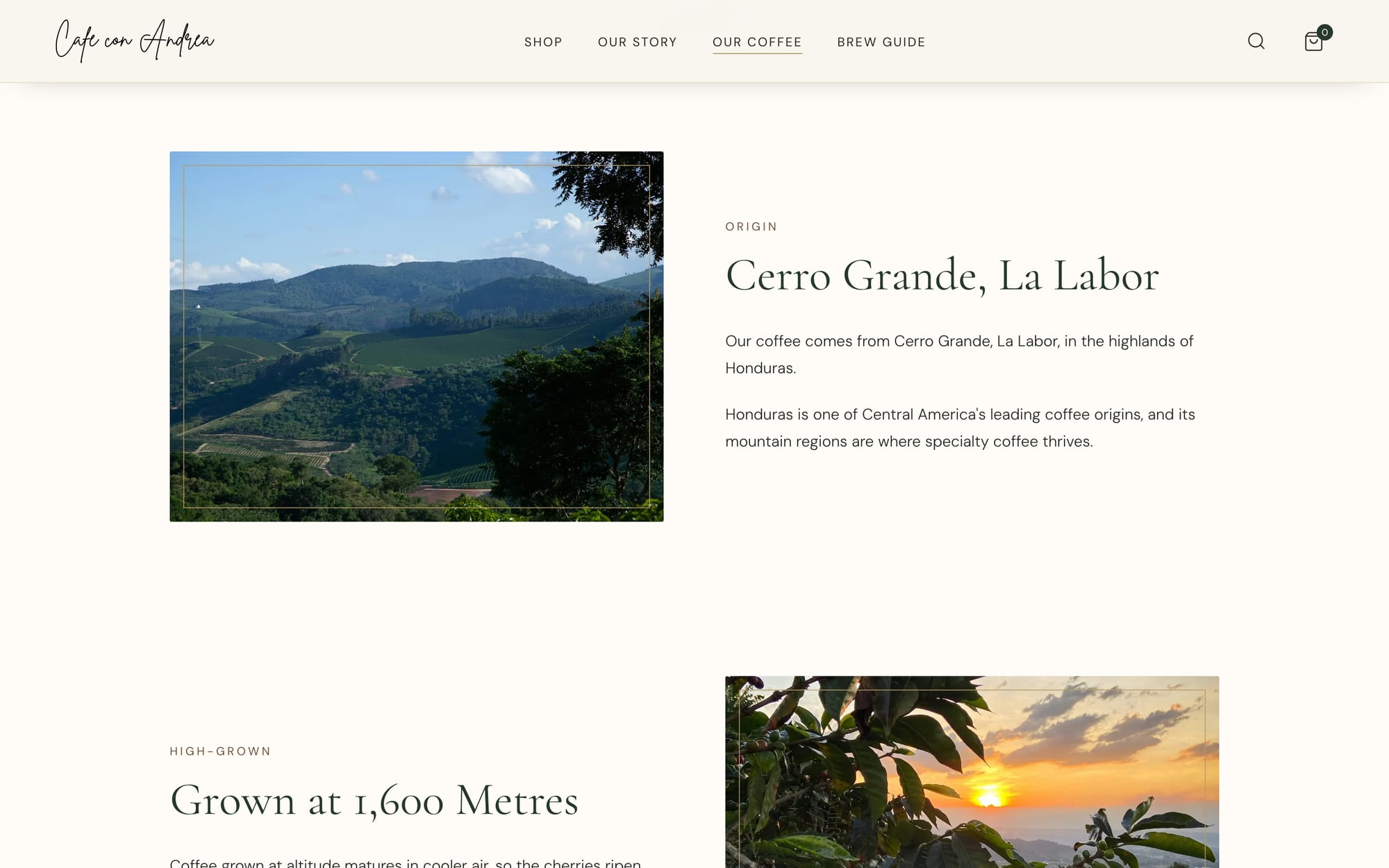
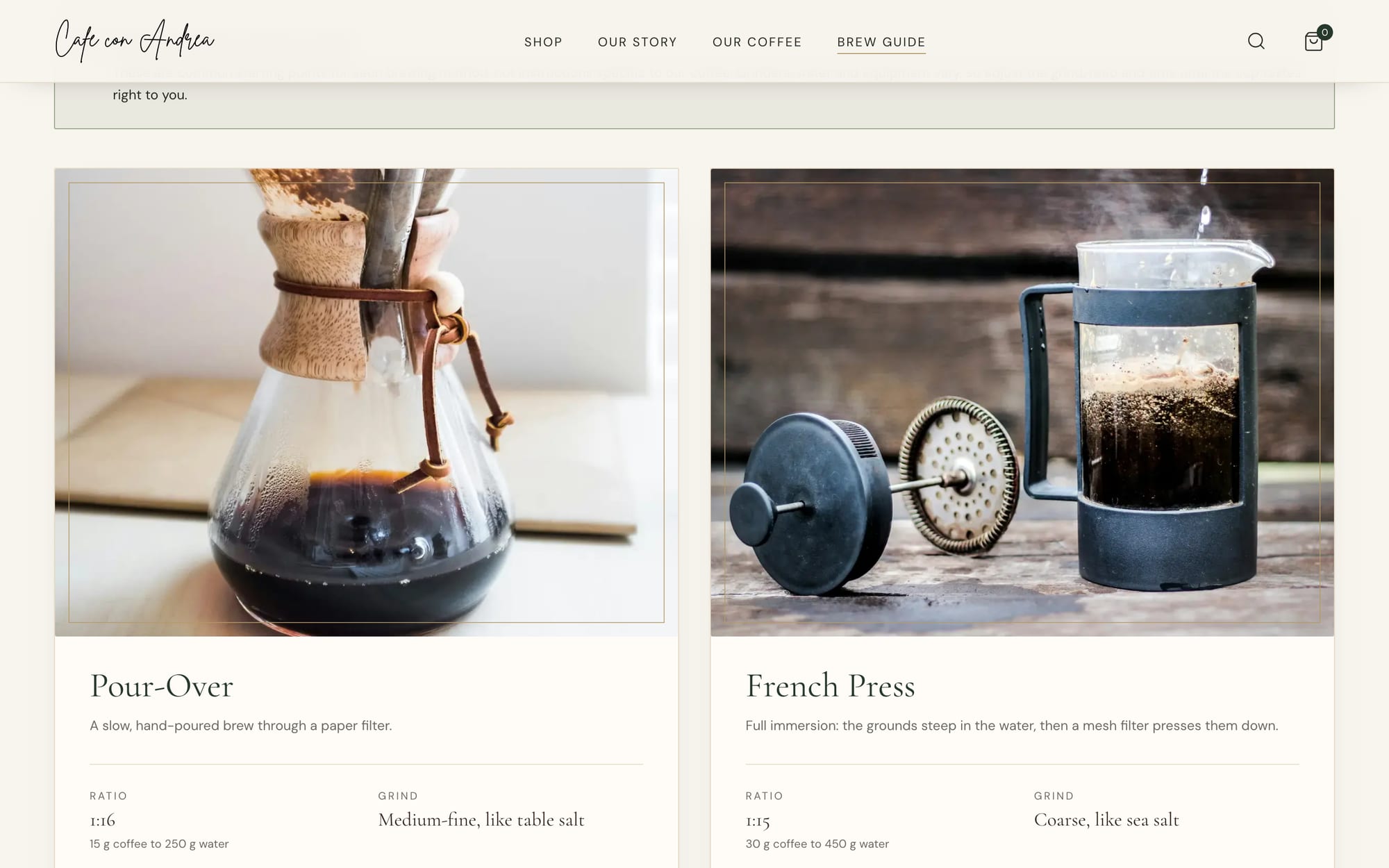
Our Coffee walks through the coffee's origin, why altitude matters, what washed processing means, the medium roast and why it's sold as whole bean. The Brew Guide covers pour-over, French press, drip and espresso, each with a starting ratio, a grind size and simple steps.
The Brew Guide opens with a note that marks it as general guidance to adjust to taste, not instructions specific to this coffee. That one sentence is the no-invented-claims rule at work: a ratio of 1:16 for pour-over is good general advice, but it isn't a claim about how this coffee should be brewed.
The rule that shaped everything: don't make anything up
It's easy to make a coffee site look finished with filler: tasting notes like "dark chocolate and stone fruit", a founder biography, a row of five-star reviews, "free shipping over $50". The brief ruled all of that out, and we built the site so it can't drift back in.
The label is the source of truth. Everything the site says about the coffee comes from what's printed on the packaging: origin, region, elevation, roast, process and format. It's kept in one small file, with a comment saying nothing in it may go beyond the label. There are no tasting notes on the site because the brand hasn't published any.
Shopify is the source of truth for anything commercial. Prices, sizes, stock and policies come from Shopify or not at all. When we added a free-shipping note to the storefront, it stays hidden until the owner sets a threshold. When we added customer reviews through Judge.me, the site shows real ratings only, and shows nothing at all until there are some.
Missing content is labelled, not invented. Andrea's own story hadn't arrived yet. Rather than write one, we built the founder sections with clearly marked placeholders and hid the homepage section until the real story is ready.
The label changed the product, too. The packaging has tick boxes for two formats, Ground and Whole Bean. Midway through the build the business decided to sell whole bean only, so we removed Ground from the product, the copy and the tests the same day, and the site now says "Roasted Whole Bean" everywhere.
Working without credentials: a demo mode that can't take an order
We started building before the Shopify store was set up, which raised a practical problem: how do you build a commerce site with no products, no prices and no checkout?
We built the site with a switch. In demo mode it serves one product built only from the label's facts, with no price ("Price set in Shopify" instead), a visible "Demo catalog" badge, a cart kept in a signed cookie, and a Checkout button that explains Shopify isn't connected yet. It can't take an order, and it doesn't pretend to. In live mode the same pages read the real store.
That meant every page, the cart and the checkout flow were designed, built and tested before the store existed. The day the credentials arrived, the switch flipped, and real products and prices appeared in the same layouts.
The brand, handled with care
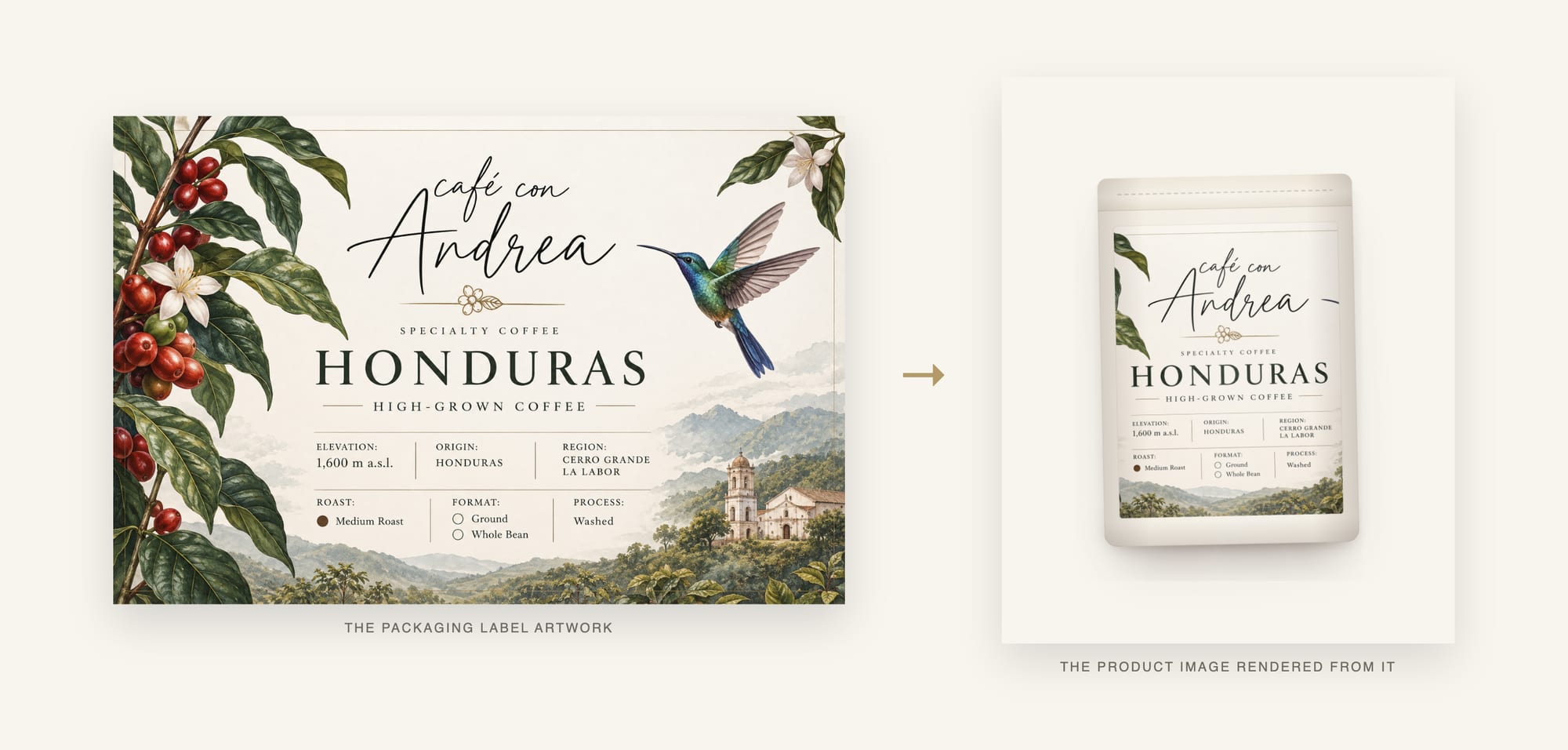
The logo is hand-lettered, and the brief was firm that it must never be retyped in a cursive font. So we didn't redraw it: a script trims the original artwork to its ink and makes the paper transparent, and every logo on the site, in the checkout and in the order emails comes from that one source.
The product photography didn't exist yet either. The site shows real photos the moment the owner uploads them to Shopify. Until then, a component draws a coffee pouch wearing the centre panel of the real label, cropped and never stretched, so customers see the actual packaging design rather than a stock bag. We also rendered that pouch to a high-resolution image the owner could upload to Shopify as a temporary product photo.
The other photographs, the hillsides, beans and brewing scenes, are licensed and logged with their source, photographer and licence. None of them is from Honduras, so their alt text doesn't claim to show a place.
More than a storefront
Once the store was connected, we kept going on the commerce side, so the owner gets a business and not just a website:
- Subscriptions: if the owner sets up Shopify selling plans, the product page offers them and carries them through the cart.
- Shipping: weight-based rates, local pickup, and an optional free-shipping threshold.
- Bundles and gift cards, with the storefront handling non-coffee products correctly.
- Reviews through Judge.me, real ratings only.
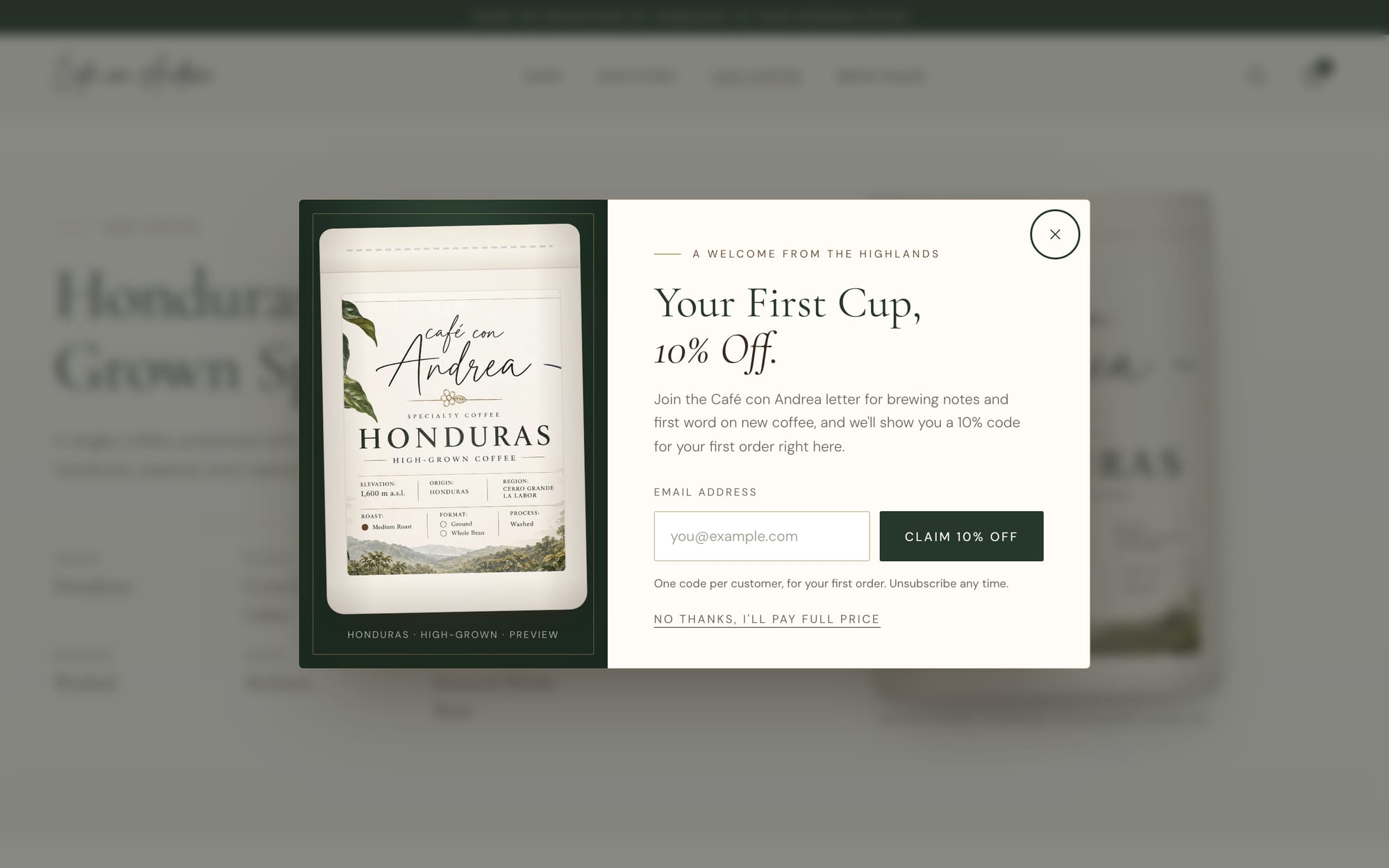
- A welcome offer: a first-visit dialog with a 10% code for the first order, which also grows the mailing list.
- Newsletter sign-ups saved straight to Shopify as subscribed customers, ready for Shopify Email.
- Google Analytics 4 and Tag Manager, with purchases tracked through Shopify's Google channel and sessions carried into the hosted checkout, so a sale is credited to the visit that led to it.
We also wrote the owner a Shopify setup runbook that walks through every setting the site depends on, step by step: the product and its metafields, payments and Shop Pay, checkout branding, shipping, bag-size variants with weights and SKUs, Shopify Email and abandoned-checkout recovery, Flow automations, and Shopify POS Lite for selling in person at markets and events.
Fast, accessible, and tested
A store that looks premium but loads slowly or locks people out isn't premium. Before calling it done:
- Every page is checked for accessibility with automated WCAG 2.2 AA audits, including with the cart and dialogs open. A serious violation fails the build. Brand colours were adjusted where they fell short: the muted grey from the brand palette was too light for small text on cream, so small copy uses a slightly darker shade that passes.
- The full customer journey is tested end to end, on desktop Chrome and an iPhone-sized Safari: homepage, product, add to cart, change quantity, and on to checkout. The tests never place a real order.
- Shopify outages are tested on purpose. A second test server pretends Shopify is down, and the suite checks that customers see a clear, honest error instead of a broken page.
- Performance is measured, not assumed. Our Lighthouse audit once scored the shop page 88 for performance on mobile, below the brief's target of 90. The first product image was arriving a fraction of a second late, so we changed how the page is built to serve it ready-made, and trimmed the card image from about 56 KB to 26 KB.
Every change ran through the same checks automatically before it could merge.
How we built it
The storefront went from an empty repository on October 23 to a complete site on October 26, 2026: 32 reviewed pull requests covering the design system, every page, the Shopify integration, the cart and checkout, SEO, analytics, tests and the owner's runbook. As with our other recent projects, much of the day-to-day implementation was done by AI coding agents working from planned tickets. We set the direction, wrote the rules down before anything was built, reviewed every change, and checked the result in a real browser on desktop and phone.
The hero was a good example of how that worked. We mocked up two homepage heroes, a still pouch and the brand's coffee-bag film, and built both behind a switch so the team could compare them on real devices with a shareable link. The film won, and choosing it took a one-line change.
See the live store at cafeconandrea.com.
Selling something you care about?
A specialty coffee brand is a good example of a business where the story is the product, and a template can only tell it so well. If you sell something with a story behind it, a custom storefront on top of Shopify gives you a site that looks and feels like your brand, while Shopify keeps doing what it does well: products, payments and orders.
KeyesCode builds custom software and websites that fit how a business already works. If you're weighing a custom build against an off-the-shelf platform, our comparison of custom software vs. off-the-shelf platforms is a good place to start, and we've written about why every small business needs a high-converting website. Or get in touch and tell us what you're selling.
Frequently asked questions
What is Café con Andrea?
Café con Andrea is a premium Honduran specialty coffee brand selling packaged coffee directly to customers. Its flagship coffee, Honduras High-Grown, comes from Cerro Grande, La Labor, in the Honduran highlands, grown at 1,600 metres above sea level, washed, and sold as a medium roast in whole bean.
What is a headless Shopify storefront?
In a headless storefront, Shopify still runs the store (products, prices, inventory, orders and checkout) but the website customers browse is a separate, custom-built site that reads that data through Shopify's Storefront API. The brand gets a site designed around its story instead of a theme, and keeps Shopify's checkout, payments and admin.
Why not just use a Shopify theme?
A theme would have worked, but the brief asked for an editorial, luxury feel built around one coffee, with complete control over typography, motion, performance and accessibility. A custom front end gave us that, while Shopify stays the source of truth for everything commercial, so the owner still manages products, prices and orders in the Shopify admin.
Does the custom site handle payments?
No. When a customer presses Checkout, the site hands their Shopify cart over to Shopify's hosted checkout, which takes the payment and confirms the order. The storefront never shows a payment form and never claims an order succeeded without Shopify confirming it.
How long did the build take?
The storefront went from an empty repository to a complete site in about four days, October 23 to 26, 2026, across 32 reviewed pull requests. That covered the design system, every page, the Shopify integration, cart and checkout, SEO, analytics, automated tests, and a step-by-step Shopify setup guide for the owner.
Can the owner update the site without a developer?
Products, prices, photos, variants, inventory, policies and orders are all managed in the Shopify admin, and the site picks up changes automatically. Editorial copy, such as the Our Story and Brew Guide pages, lives in a small typed configuration layer, with a documented path to moving it into Shopify metaobjects if the owner wants to edit it there too.
Have a project in mind?
Tell us what you're trying to build or fix, and we'll give you a straight answer on what we'd do next. No pitch, no pressure.