Generative AI Consulting for Small and Mid-Size Businesses: Costs, Deliverables, and When to Skip It
A plain guide to generative AI consulting for small and mid-size businesses: what an audit, a pilot and a production build each deliver, what they typically cost, how to check the payback, and when you should skip the consultant entirely.
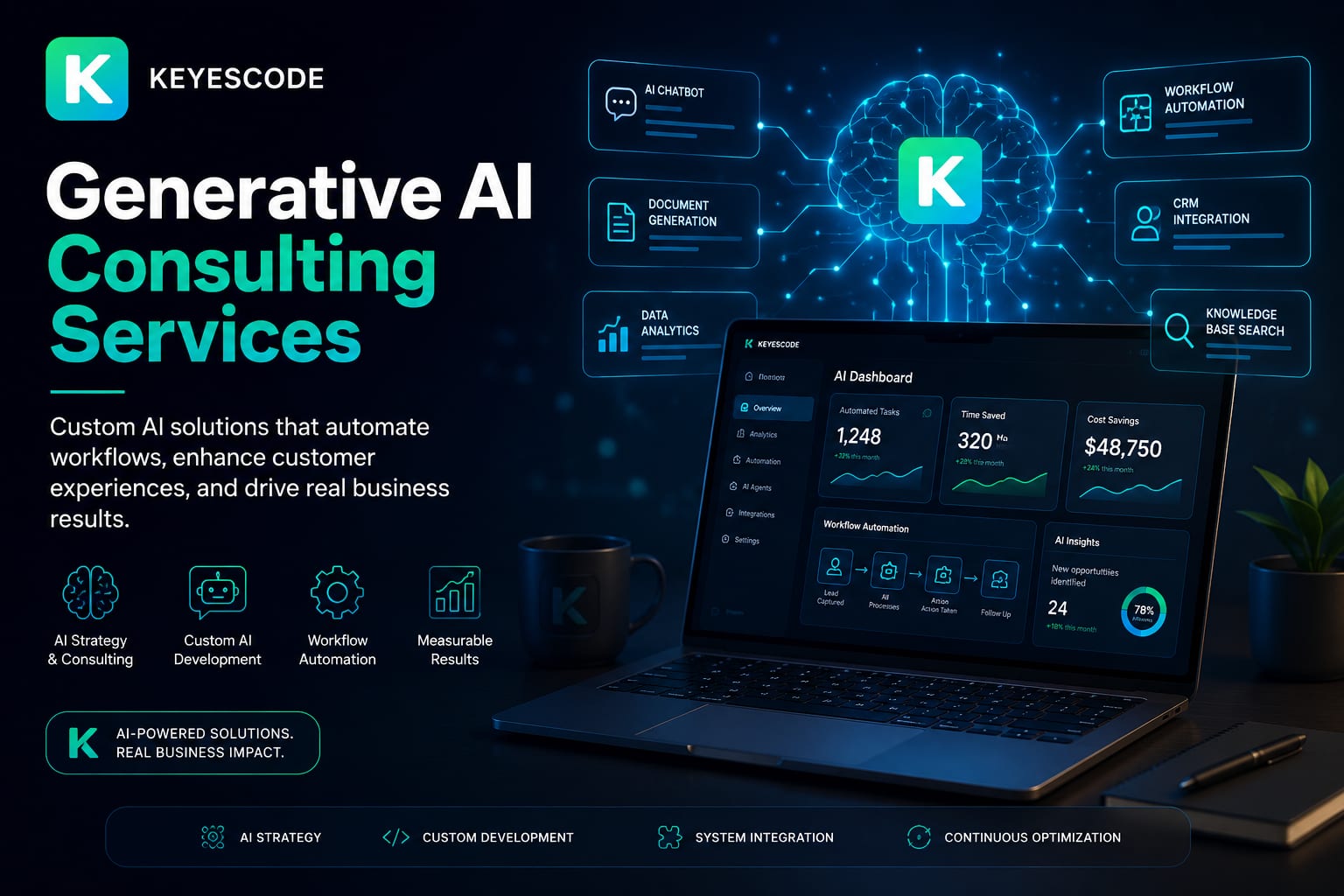
Most of what gets written about generative AI consulting is aimed at companies with an innovation budget and a steering committee. If you run a business with 10 to 200 people, your question is smaller and more practical: what would a consultant actually do for me, what would it cost, and is it worth more than a few ChatGPT subscriptions?
This guide answers those three questions. It is written by a team that builds these systems for small and mid-size businesses, so it also covers when you should not hire a consultant at all, us included.
Who this guide is for
Owner-operators and managers at companies with roughly 10 to 200 staff: home services, professional services firms, clinics, agencies, e-commerce brands, and nonprofits. You probably recognize most of this list:
- No in-house engineering team, or one that is already fully booked.
- A few people using ChatGPT or Copilot on their own, with no shared policy.
- One or two processes everyone agrees are a time sink: answering the phones, quoting, client intake, follow-up, reporting.
- A budget that has to be justified in hours saved or revenue recovered, not in "strategic positioning."
If that is you, a six-month transformation program is the wrong product. What you need is narrower, cheaper, and easier to judge.
What generative AI consulting services actually include
Strip away the jargon and generative AI consulting for businesses comes in three stages. Each one ends with something you can hold, and you can stop after any of them.
1. Audit and roadmap
A consultant interviews the people who do the work, looks at the systems and data you already have, and lists the places AI could help. Those candidates get ranked by expected return and by how hard they are to build.
What you get: a written assessment that says what to build, what to buy off the shelf, what to skip, and which project should go first, with a rough cost and payback estimate for each.
2. Pilot
Also called a proof of concept. Instead of debating whether an idea will work, you build the riskiest part of it on your real data in a short, fixed sprint.
What you get: something your team can actually try, a measured result (accuracy, time per task, how often a person has to step in), and a clear go or no-go. A pilot that ends in "don't build this" has done its job.
3. Production build
This is the step that turns a promising pilot into something that runs every day: integrations with the software you already use, permissions, monitoring, quality checks, and a fallback to a human when the AI is unsure.
What you get: a deployed system, the code in an account you own, documentation, and a handoff so you are not dependent on the people who built it.
For a small or mid-size business, the projects that come out of this process are usually unglamorous:
- An AI receptionist that answers calls, qualifies leads, and books appointments after hours.
- A website chatbot trained on your own services and policies.
- Lead follow-up and CRM updates that happen without anyone re-typing notes.
- Document intake: pulling fields out of forms, invoices, and PDFs.
- Internal knowledge search across your files, so new staff stop asking the same five questions.
- First drafts of proposals, quotes, and meeting summaries.
- Reporting that pulls numbers from several systems into one place.
Most of the value comes from connecting AI to systems you already run: your CRM, Google Workspace or Microsoft 365, Shopify, Slack, your database. A model that only knows the public internet is a toy. One that can read your job history and write to your calendar is a tool.
What generative AI consulting costs
Prices vary by firm, but for a business your size the bands look like this:
| Stage | Typical timeline | Typical range | What moves it |
|---|---|---|---|
| Audit and roadmap | 2 to 3 weeks | $3,000 to $8,000, fixed fee | Number of departments and systems reviewed |
| Pilot (proof of concept) | 2 to 4 weeks | $8,000 to $20,000, fixed fee | How messy the data is, how many integrations the test needs |
| Production build | 6 to 12 weeks | $20,000 to $75,000 | Integrations, user roles, compliance, how much human review is required |
| On-demand advisory | Monthly | $2,000 to $6,000 per month | Hours per month, whether it includes hands-on work |
The assumptions behind those numbers:
- One use case at a time. The ranges describe a single workflow, not a company-wide program.
- Senior engineers doing the work. Offshore or junior teams quote less per hour. They rarely cost less per outcome.
- Your data is reachable. If the information lives in paper files or in one person's head, getting it into a usable form is its own project.
- No heavy compliance layer. Healthcare, finance, and legal work adds private model deployments, audit trails, and review steps, which push a project toward the top of its band or past it.
Then there are running costs, which people forget to ask about. Model usage for a typical small-business text workload usually lands somewhere between tens and a few hundred dollars a month. Voice agents cost more, because phone minutes and speech are billed per minute. Ask for a monthly estimate at your real volume before you sign anything.
Three things move a quote more than anything else: how many systems the AI has to connect to, what shape your data is in, and how expensive a wrong answer would be. A chatbot that gives a slightly clumsy reply costs you little. An agent that sends the wrong quote to a customer costs you a lot, so it needs more testing and more human review.
How to tell if it will pay off
Do the arithmetic before you take a sales call. As an illustration, not a client result: a front-office team that spends 25 hours a week between them re-keying intake forms, at a loaded cost of $35 an hour, is about $45,500 a year of work. A system that removes 70 percent of it returns roughly $31,900 a year. Against $35,000 for a pilot and a build, that is about a 13-month payback. That is reasonable, not spectacular, and worth knowing before anyone writes a line of code. Run the same numbers on a task that takes three hours a week and the answer is no.
The same math works on the revenue side. Count the calls you miss in a month, multiply by your close rate and your average job value, and you have the ceiling for what an AI receptionist could recover.
If you want the full method, including the cases where the honest answer is "not yet," read Should Your Small Business Use AI? An ROI-First Decision Framework.
You don't need an AI consultant if…
A good share of the businesses that ask about AI consulting should spend their money elsewhere. Skip the consultant when:
- An off-the-shelf tool already does the job. If the AI features inside your CRM, help desk, or phone system cover the workflow, turn them on. We compare the two routes in custom software vs off-the-shelf platforms.
- The need is personal productivity. Drafting emails, summarizing documents, brainstorming. Buy team seats for ChatGPT or Claude, write a one-page policy on what data may be pasted in, and you are done.
- You can't name the process or the number. "We should be using AI" is not a project. "We miss about 30 calls a week after 5 p.m." is.
- The volume is too low. A task that happens five times a month will not pay back a build.
- The process itself is broken. Automating a workflow nobody has agreed on just makes the confusion faster. Fix the process first.
You probably do need help when the AI has to connect to your own systems, when it talks to customers or takes actions on its own, when regulated data is involved, or when you already ran a pilot that impressed everyone and then quietly died.
Why vendor-neutral AI consulting matters
Many AI consultants are resellers. They earn a commission or hold a partner quota for one platform, and their recommendations reliably end at that platform. Vendor-neutral AI consulting means the recommendation is based on your task, your budget, and your data, and nothing else.
At KeyesCode we work across OpenAI, Anthropic Claude, AWS Bedrock, Azure OpenAI, and open-weight models that run in your own cloud. We take no reseller commissions, and we design systems so you can switch model providers without a rewrite. Models leapfrog each other every few months, so the provider that is best today may not be best next year.
Four questions worth asking any consultant, including us:
- Are you paid by any vendor you recommend?
- Who owns the code, the prompts, and the data when the engagement ends?
- Can I change model providers later without rebuilding?
- What happens to the system if I stop paying you?
On-demand and customized: how engagements are structured
You do not need a long contract to get useful advice. Our engagements are staged the way this guide is: a fixed-fee audit, then a fixed-fee pilot scoped to one use case, then a build only if the pilot earns it. You own the audit and the roadmap whether or not we build anything.
For teams that want AI consulting services on demand, such as a second opinion on a vendor pitch, a review of a pilot that stalled, or a few hours a month of fractional AI leadership, ongoing advisory runs as a monthly retainer with no lock-in.
"Customized" should mean built around your process and data, not a template with your logo on it. It should not mean custom everything. A sound recommendation usually mixes off-the-shelf tools with a small amount of custom work at the points where your business is actually different.
AI consulting in Tampa and Los Angeles
KeyesCode is headquartered in Tampa, Florida. We meet clients in person across Hillsborough, Pinellas, and Pasco, which helps more than you would expect, because mapping a real workflow is easier in the room than on a video call. If you are looking for AI consulting services in Tampa, FL, start with our Tampa AI development page.
Los Angeles is our second focus market. We work on-site across Los Angeles County for kickoffs and working sessions and remote-first for the build. Details are on the Los Angeles AI development page.
A note for nonprofits in either city: the staged approach suits grant-funded budgets. An audit is a small, fixed line item with a written deliverable, and it tells you whether a larger request is worth writing.
The short version
- Generative AI consulting for a small or mid-size business is three things: an audit, a pilot, and a build. Buy them one at a time.
- Expect $3,000 to $8,000 for an audit, $8,000 to $20,000 for a pilot, and $20,000 and up for a production system. Ask about monthly running costs.
- Skip the consultant if an existing tool does the job or you cannot name the number you want to move.
- Insist on vendor neutrality and on owning what gets built.
If you would like a straight answer on whether an engagement is worth it for your business, see our AI consulting services or book a call. If the answer is "you don't need us," we will say so.
Frequently asked questions
How much does generative AI consulting cost for a small business?
For one workflow, expect roughly $3,000 to $8,000 for a fixed-fee audit and roadmap, $8,000 to $20,000 for a two-to-four-week pilot, and $20,000 to $75,000 for a production build. Ongoing advisory typically runs $2,000 to $6,000 a month. Those ranges assume senior engineers, data you can already reach, and no heavy compliance requirements. Model usage is billed separately, usually tens to a few hundred dollars a month.
What do generative AI consulting services for businesses include?
Three stages. An audit and roadmap ranks where AI could help and says what to build, buy, or skip. A pilot builds the riskiest part of the best idea on your real data and measures the result. A production build connects it to the software you already use, with monitoring and a human fallback. You can stop after any stage.
What is vendor-neutral AI consulting?
It means the consultant is not paid by or tied to any AI platform, so the recommendation depends only on your task, budget, and data. KeyesCode works across OpenAI, Anthropic Claude, AWS Bedrock, Azure OpenAI, and open-weight models, takes no reseller commissions, and designs systems so you can switch providers without a rewrite.
Can I get AI consulting services on demand, without a long contract?
Yes. Advisory work runs as a monthly retainer with no lock-in: a second opinion on a vendor pitch, a review of a stalled pilot, or a few hours a month of fractional AI leadership. Project work is staged as a fixed-fee audit, then a fixed-fee pilot, then a build only if the pilot earns it.
Do you offer AI consulting services in Tampa, FL?
Yes. KeyesCode is headquartered in Tampa and meets clients in person across Hillsborough, Pinellas, and Pasco counties. Engagements usually start with a short readiness audit, followed by a two-to-four-week proof-of-concept sprint on the highest-value use case.
Do you work with businesses and nonprofits in Los Angeles?
Yes. Los Angeles is our second focus market. We work on-site across Los Angeles County for kickoffs and working sessions and remote-first for the build. For nonprofits, the staged approach fits grant-funded budgets: the audit is a small fixed line item with a written deliverable.
When does a small business not need an AI consultant?
When an off-the-shelf tool already covers the workflow, when the need is personal productivity that team ChatGPT or Claude seats would solve, when the task happens too rarely to pay back a build, or when you cannot yet name the process and the number you want to improve. In those cases, buy the tool or fix the process first.
Want this kind of result for your business?
We'll audit your site for conversion gaps and suggest 2–3 AI integrations you could ship in 30 days. No pitch, no pressure.