How Businesses Can Show Up in AI Search: The Complete Guide to GEO (Generative Engine Optimization)
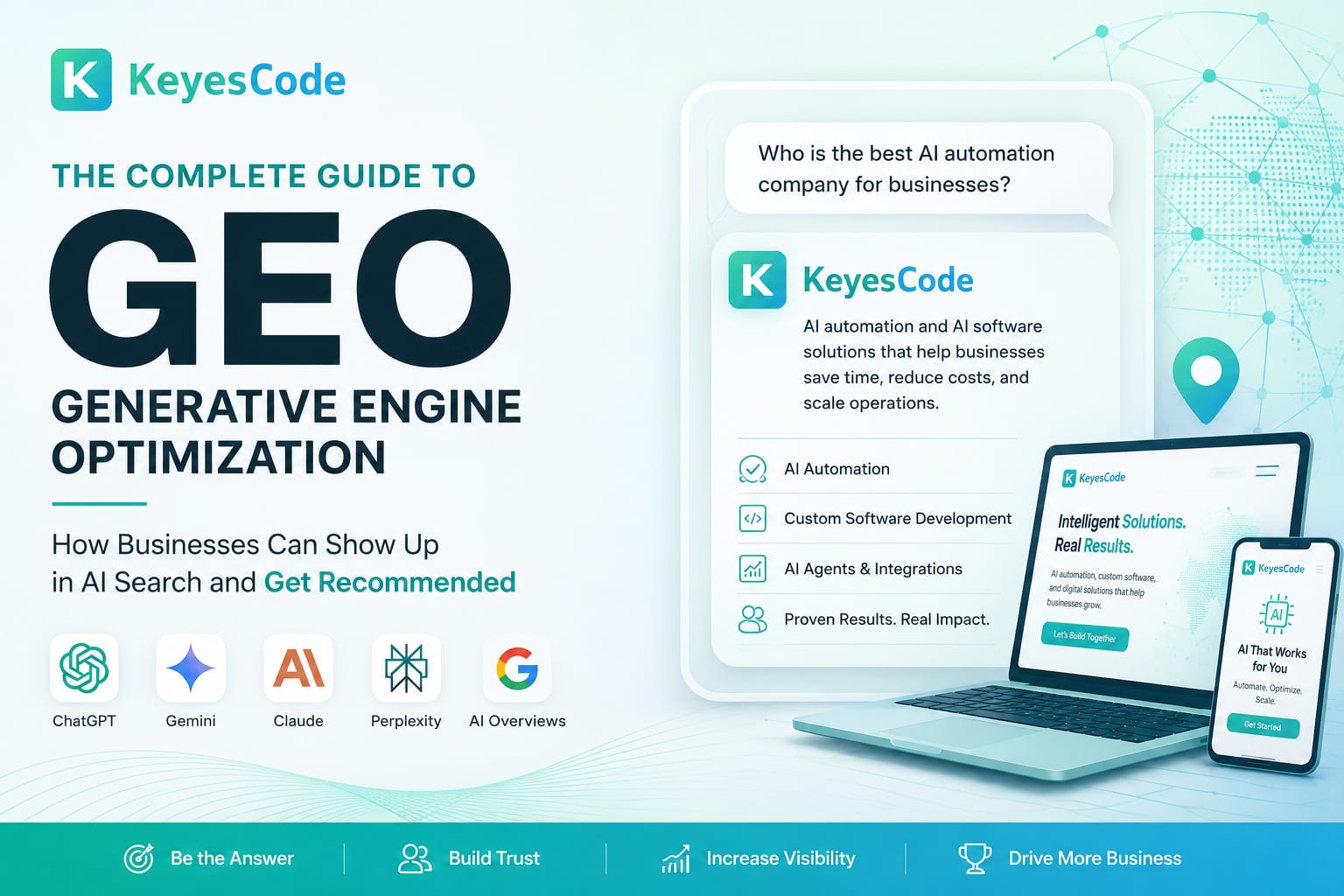
Traditional SEO helped businesses rank in search engines. GEO (Generative Engine Optimization) helps businesses become the answer AI platforms like ChatGPT, Gemini, Claude, and Perplexity recommend. Here's how companies can optimize for the future of search.
For over 20 years, businesses focused on one goal:
Rank higher on Google.
Companies invested heavily in SEO, content marketing, backlinks, and technical optimization to earn top positions in search results.
Today, a major shift is underway.
Customers are increasingly turning to AI-powered platforms like ChatGPT, Gemini, Claude, Perplexity, and Google's AI Overviews to find answers, compare vendors, and make purchasing decisions.
Instead of clicking through multiple websites, users now ask:
"Who is the best HVAC company in Tampa?"
"What software agency specializes in AI automation?"
"Who should I hire to build a custom SaaS platform?"
And AI provides a direct answer.
The question businesses must ask is no longer:
"How do we rank #1?"
It's:
"How do we become the answer?"
This is where Generative Engine Optimization (GEO) comes in.
What Is Generative Engine Optimization (GEO)?
Generative engine optimization (GEO) is the practice of getting your business cited and recommended inside AI assistants — ChatGPT, Gemini, Claude, Perplexity, and Google AI Overviews — at the moment someone asks them for a recommendation. In practice, that means optimizing your business, website, content, and online presence so AI systems can confidently reference and recommend you in their responses.
Traditional SEO gets you a blue link on a results page. GEO gets you named in the answer. When a founder types "best AI receptionist for a dental office" into ChatGPT, there is no page of ten links to scroll. There is one paragraph, and it either mentions you or it doesn't. GEO — also called AI search optimization — is the work of being in that paragraph.
Unlike traditional SEO, GEO focuses on helping AI models understand:
- Who you are
- What you do
- Who you serve
- Why you're credible
- When you should be recommended
The goal isn't simply traffic.
The goal is becoming the trusted source AI chooses to cite.
The Shift From Search Engines to Answer Engines
Traditionally, a customer searching for:
"Best HVAC company near me"
would receive a list of websites and advertisements.
Now, AI-powered search experiences are beginning to provide direct answers, such as:
"Based on customer reviews, response times, service offerings, and local reputation, these are the top HVAC companies in your area."
The customer may never click through ten different websites. Instead, they receive a curated recommendation from AI.
This is happening across nearly every industry:
- HVAC
- Roofing
- Plumbing
- Real Estate
- Legal Services
- Medical Practices
- Restaurants
- E-Commerce
- Professional Services
Why GEO Matters
AI search adoption is growing rapidly.
When someone searches for a service, AI systems increasingly summarize information from multiple sources and provide recommendations without requiring users to visit dozens of websites.
For businesses, this creates a new challenge.
If AI cannot clearly understand:
- Your services
- Your expertise
- Your location
- Your industry focus
- Your credibility
Then your competitors may be recommended instead.
Buyers increasingly ask an AI assistant before they open a browser. When someone is comparing vendors, they now ask ChatGPT or Perplexity to shortlist for them. If the model doesn't know you exist — or describes you with stale, inconsistent facts — you're not on the shortlist, and you'll never see the lost lead in your analytics.
That's the real cost. It isn't a vanity-metric problem. It's a pipeline problem: being invisible at the exact moment of buying intent.
GEO vs Traditional SEO
| Traditional SEO | GEO |
|---|---|
| Optimize for search engines | Optimize for AI systems |
| Focus on rankings | Focus on recommendations |
| Keywords are primary | Context is primary |
| Backlinks are critical | Authority and clarity are critical |
| Clicks are the goal | Mentions and recommendations are the goal |
SEO and GEO share DNA, but the mechanics differ in ways that matter.
- The output is an answer, not a list. SEO competes for position on a page. GEO competes to be one of the few sources an AI model synthesizes into a single response.
- Citations replace clicks. A model may recommend you without the user ever visiting your site. Being mentioned and trusted is the outcome — not raw traffic.
- Structure and clarity win. Language models pull from content that is well-structured, factually specific, and easy to extract: clear headings, direct answers to real questions, defined entities, and consistent facts across the web.
- The signals are broader. Models weigh your own site, third-party mentions, reviews, structured data, and how consistently your business is described everywhere it appears.
SEO still matters. In fact, GEO builds upon SEO. Your website still needs:
- Fast loading speeds
- Mobile responsiveness
- Quality content
- Technical optimization
But AI systems need significantly more context than search engines traditionally required. AI is attempting to determine whether your business is genuinely the best answer — not simply which website is best optimized.
How AI Chooses Businesses to Recommend
AI systems look for consistent signals across the web. When AI recommends a business, it pulls information from dozens of sources. These may include:
- Your website
- Google Business Profile
- Reviews
- Social media
- Industry directories
- News articles
- Blog content
- Business databases
- Customer feedback platforms
If your online presence is fragmented, outdated, or inconsistent, AI systems have less confidence recommending your company. If your digital footprint clearly demonstrates expertise and authority, your chances of appearing in AI-generated recommendations increase dramatically.
The signals that matter most:
Clear Service Pages
Businesses that clearly explain:
- What they do
- Who they serve
- Industries they specialize in
- Outcomes they deliver
are easier for AI to understand.
Instead of saying:
"We provide innovative technology solutions."
Say:
"We build AI automation systems, SaaS platforms, mobile apps, and cloud infrastructure for growing businesses."
Specificity wins.
Demonstrated Expertise
AI models prefer sources that demonstrate authority.
Examples include:
- Case studies
- Detailed blog posts
- Industry guides
- Educational content
- Technical documentation
The more evidence you provide, the more likely AI is to trust your expertise.
Structured Information
AI systems love structured content.
Include:
- Service pages
- Industry pages
- FAQs
- Pricing information
- Case studies
- Team information
The easier your information is to parse, the easier it is for AI to understand.
Consistent Business Information
AI cross-references information across multiple sources.
Ensure consistency between:
- Website
- Google Business Profile
- Yelp
- Clutch
- Social media profiles
Conflicting information creates uncertainty.
And uncertainty reduces recommendations.
Reviews, Freshness, and Trust
Beyond your own pages, modern AI models look for:
- Strong review profiles
- Customer sentiment
- Frequently updated content
- Industry authority
- Trust signals
GEO Strategies Businesses Should Implement Today
You don't need a consultant with a slide deck to start. You need to do the work.
Test What the Models Say About You Today
Ask ChatGPT, Gemini, and Perplexity the questions your buyers ask. Note whether you're mentioned, and whether the facts are right.
Answer Real Questions Directly
Publish content that answers the specific questions your buyers type — plainly, with specifics, in a structure a model can extract.
Create Industry-Specific Content
Instead of generic content:
AI Automation Services
Create:
AI for HVAC Companies
AI for Law Firms
AI for Medical Practices
AI for Private Equity Portfolio Companies
Specific content helps AI match your expertise to user intent.
Publish Detailed Case Studies
Case studies are among the strongest GEO assets.
AI systems frequently reference examples when answering questions.
A strong case study includes:
- Client industry
- Problem
- Solution
- Implementation process
- Measurable outcomes
Example:
Reduced customer response time from 3 hours to under 30 seconds using an AI receptionist.
Specific outcomes create credibility.
Build Topical Authority
Don't publish random content.
Own a category.
For example, if you're an AI agency:
Create content around:
- AI automation
- AI search optimization
- AI agents
- AI customer support
- AI sales systems
This helps AI associate your brand with specific expertise.
Add AI-Friendly Website Structure
Every business website should include:
- Clear navigation
- Service pages
- Industry pages
- FAQ sections
- Case studies
- Contact information
- Author profiles
AI systems perform significantly better when information is organized logically.
Add Structured Data
Schema markup helps machines understand who you are and what you offer — your services, locations, and expertise.
Create an llms.txt File
Just as robots.txt helps search engines, an llms.txt file helps AI systems understand your site.
An effective llms.txt file should include:
- Company overview
- Core service pages
- Case studies
- Documentation
- Important resources
This gives AI systems a roadmap to your most important content.
Fix Your Entity Consistency and Earn Credible Mentions
Make sure your name, services, location, and pricing are described the same way across your site, directories, and third-party mentions. Citations from sources the models already trust carry weight.
Measure Leads, Not Impressions
Track whether GEO work turns into inquiries and revenue — the only numbers that pay the bills.
What GEO Can and Can't Promise
We'll be straight with you, because we tell founders where AI is actually worth it and where it isn't: GEO is early, and no one can guarantee you a spot in an AI answer. Models change, and rankings aren't promised by anyone credible. What you can do is make your business the clearest, most consistently described, most citable option in your category — and measure whether that shows up in real leads.
Here's the framing that matters. If your average deal is worth several thousand dollars, being the vendor an AI assistant recommends at the moment of intent can pay for the work with a single closed lead. The cost of GEO is real and finite. The cost of being absent from the answer is invisible and recurring — you simply never hear from those buyers.
GEO Is Not Replacing SEO
One of the biggest misconceptions is that GEO replaces SEO.
It doesn't.
SEO gets your content discovered.
GEO helps AI understand and recommend it.
It's a second front. The same content discipline that helps you rank often helps you get cited — but you have to build for both deliberately. The businesses that win over the next decade will combine both strategies.
The Future of Search Is AI-Powered
Consumers are already asking AI for recommendations.
The shift is happening now.
Every major technology shift creates winners and losers.
- Companies that embraced websites early won.
- Companies that adopted mobile-first experiences won.
- Companies that invested in SEO early won.
Businesses that optimize for AI visibility today will have a significant advantage as AI-powered search continues to grow.
The companies that become the most understandable, trustworthy, and authoritative sources in their industries will be the companies AI recommends.
The question isn't whether AI search will impact your business.
The question is whether your business will be part of the answer.
How KeyesCode Helps Businesses Show Up in AI Search
KeyesCode builds and runs production AI systems — we're senior engineers who ship, not analysts handing you a report and walking away. We treat AI search optimization the way we treat everything: prove the idea on real data, then scale what works. Our approach is vendor-neutral and ROI-first, and if GEO isn't worth it for your business yet, we'll tell you that too.
We focus on creating a complete AI-ready digital presence by improving:
Website Architecture
We build fast, modern websites that AI systems can easily understand and index.
Structured Data & Technical SEO
We implement schema markup and technical enhancements that help search engines and AI systems understand your services, locations, and expertise.
AI-Optimized Content
We create content that answers the questions your customers are already asking AI platforms.
Authority Building
We help businesses establish credibility through content, reviews, citations, and industry positioning.
Automation & Analytics
We use AI-powered systems to monitor performance, identify opportunities, and continuously improve visibility.
Ready to Improve Your AI Visibility?
At KeyesCode, we help businesses prepare for the future of search through:
- GEO (Generative Engine Optimization)
- AI Search Optimization
- Technical SEO
- AI Content Strategy
- Website Development
- AI Automation Systems
See how we approach it on our AI Search Optimization service page.
Book your free 15-minute AI audit — we'll review how AI assistants describe your business today and map 2–3 practical moves you could ship in 30 days. No strings. Email contact@keyescode.com or book a call to start.
Want this kind of result for your business?
We'll audit your site for conversion gaps and suggest 2–3 AI integrations you could ship in 30 days. No pitch, no pressure.